Why Small Towns Are Becoming the New Digital Nomad Destinations (in South Africa)
- Alma CWO | KML
- 1 day ago
- 21 min read
As remote work changes the way people live and travel, a new generation of digital nomads is beginning to look beyond the world's major cities. In places like Swellendam, the combination of nature, community, affordability and a slower pace of life could offer something that traditional digital-nomad destinations increasingly struggle to provide.
The Digital Nomad Dream Is Changing
There was a time when the digital nomad lifestyle seemed to have a very specific formula. You needed a laptop, reliable Wi-Fi and a passport, and suddenly the world became your potential office. Bali, Lisbon, Chiang Mai, Mexico City and Cape Town became magnets for people who had discovered that their income no longer needed to be tied to a particular desk or office building. The idea was exciting because it represented a fundamental change in how people thought about work. If you could earn your living online, why should you have to live in the same city all year?
For many people, the answer was to travel as much as possible. They moved between countries, spent a few weeks in one destination and then continued somewhere else. They worked from cafés, rented apartments, joined coworking spaces and built friendships with other travellers doing exactly the same thing. The digital nomad became a recognisable type of traveller: independent, mobile, curious and increasingly able to separate the concept of earning an income from the concept of having a permanent physical workplace.
But after years of remote work becoming more normal, the idea is beginning to evolve. Constant movement sounds exciting until you have packed and unpacked your belongings for the twentieth time, searched for reliable Wi-Fi in another unfamiliar apartment and tried to maintain a productive work schedule while changing countries every few weeks. For some travellers, the freedom to work anywhere has created a desire to move less, rather than more.
The question is changing from "Where can I work?" to "Where would I actually like to live for a while?"
That is a much more interesting question for smaller towns.
A remote worker who is looking for a temporary home doesn't necessarily need a huge selection of nightclubs, international restaurants or coworking spaces. They might care more about whether they can walk somewhere beautiful after work, whether they can afford to stay for several weeks, whether there are other people around, whether they can cook their own meals and whether the environment makes everyday life feel better.
This is where small towns such as Swellendam begin to become interesting.
Swellendam sits beneath the Langeberg Mountains in South Africa's Western Cape, roughly 220 kilometres from both Cape Town and George. It has the practical advantage of being located on the N2, while also offering direct access to some of the region's most impressive natural landscapes. The town's position makes it a convenient stop between Cape Town and the Garden Route, but there is increasingly a reason to consider staying rather than simply passing through.
The appeal is not that Swellendam has everything a major city has. It doesn't. The appeal is that it offers something different: space, nature, history, community and a slower pace of life, while still having the basic infrastructure needed to make a longer stay realistic.

The First Generation of Digital Nomads Chose Cities
When remote work first became a serious lifestyle option, cities were the obvious choice. They already had the infrastructure that independent workers needed. International airports made them easy to reach, cafés provided places to work, coworking spaces offered reliable internet and desks, and large populations meant that meeting other people was relatively easy.
There was also a social advantage to being in an established digital-nomad destination. You could arrive in Lisbon or Chiang Mai knowing that there would already be a community of people who understood why you were there. A developer from Germany could meet a designer from Australia, a freelancer from Canada and an entrepreneur from the United States within a few days. The city provided not only a physical location but also a ready-made social network.
Cape Town has developed a similar appeal. It combines an international airport, excellent restaurants, a strong creative and technology sector, a large tourism industry and an extraordinary natural environment. Table Mountain, the Atlantic coastline, the Winelands and the city's cultural attractions make it an obvious choice for anyone looking for a South African base.
However, successful destinations eventually experience the same problem that affects successful cities everywhere: popularity changes the experience.
As more travellers arrive, accommodation becomes more competitive. Popular neighbourhoods become busier. Traffic takes up more time. The cost of living can increase. Tourist districts become more crowded, and the lifestyle that originally attracted people can gradually become harder to access.
None of this makes major cities unsuitable for remote workers. In many cases, they remain excellent options. The point is that they are only one model.
The digital nomad market is becoming more sophisticated. People now understand that having the freedom to work from anywhere doesn't mean they have to choose the most famous destination. They can choose based on lifestyle instead.
And once lifestyle becomes the primary consideration, small towns start looking considerably more attractive.
What Does a Remote Worker Actually Need?
The difference between a tourist and a remote worker becomes obvious when you look at what each person needs from a destination.
A tourist might spend most of their time asking what they can see and do. A remote worker needs to think about what everyday life will actually be like. They need reliable internet, a comfortable place to work, somewhere to buy groceries, access to laundry facilities and accommodation that feels comfortable enough to live in rather than simply sleep in.
They also need to think about what happens when work finishes.
That last question is particularly important.
A destination can have excellent Wi-Fi and still be a terrible place for remote work if there is nothing enjoyable to do outside working hours. Spending eight hours inside a beautiful apartment and then another four hours watching Netflix because there is nowhere to go isn't necessarily the lifestyle people imagined when they became location independent.
This is one reason smaller towns can compete so effectively.
A remote worker doesn't necessarily need a hundred restaurants. They need a few good places where they can eat. They don't necessarily need a large entertainment district. They need something worthwhile to do at the end of the day. They don't necessarily need a coworking space on every corner. They need somewhere quiet and comfortable where they can concentrate.
The priorities become much more closely aligned with quality of life.
A good remote-work destination needs to provide the basics, but the surrounding lifestyle can become more important than the size of the infrastructure.
For someone staying in Swellendam, that might mean having reliable internet and a comfortable workspace during the morning, followed by a walk, cycle, hike or trip into the surrounding countryside in the afternoon. The workday remains productive, but the environment around it is completely different from that of a conventional city office.
That is the real opportunity.
The Real Luxury Is Time
One of the biggest promises of remote work is freedom, but freedom is only useful if it creates more time for the things you actually care about.
A person living in a large city can easily spend an hour commuting each way. Even if they work from home, they may still spend considerable amounts of time dealing with traffic, shopping, parking, crowded public spaces and the general friction of urban life.
In a smaller town, those distances can shrink dramatically.
That means the working day can become more contained. You might work from eight until four, close your laptop and be outside almost immediately. There is no commute separating work from the rest of your life.
This is particularly valuable in a place surrounded by nature.
In Swellendam, the Langeberg Mountains form an enormous natural backdrop to the town. Marloth Nature Reserve extends into the mountains, while Bontebok National Park lies just outside town. The Breede River and surrounding countryside provide further opportunities for outdoor activities.
The result is that the hours outside work can feel much larger.
A remote worker could spend the morning dealing with clients in Europe, work through the afternoon, close the laptop and still have time for a walk in the mountains before dinner.
That is a different definition of productivity.
The goal isn't necessarily to work less. It is to waste less time around the work.

The Digital Nomad Isn't Always Nomadic Anymore
The word "nomad" implies movement, but constant movement isn't necessarily the ultimate expression of freedom.
There is a point where travelling constantly becomes tiring. Every new destination requires some degree of adjustment. You need to find accommodation, figure out transport, understand the local area, establish an internet connection and create a new routine. If you're also trying to maintain a demanding job, the process can become surprisingly disruptive.
This is why longer stays are becoming increasingly attractive.
Instead of visiting ten countries in a year, a remote worker might visit four. Instead of staying somewhere for three nights, they might stay for three weeks. Instead of trying to see everything, they can choose a destination and actually experience what it is like to live there.
This style of travel is often described as slow travel, but for remote workers it has another advantage: productivity.
It is much easier to establish a working routine when you know you are going to be in the same place for several weeks. You can unpack properly. You can find your favourite coffee shop. You can learn where the supermarket is. You can make friends rather than constantly saying goodbye.
You also start experiencing the destination differently.
The first few days are about discovering what there is to see.
The second week is about choosing what you actually want to do.
After a month, you may stop thinking about sightseeing altogether.
You simply live.
You work.
You cook.
You go for a walk.
You meet people.
You explore when you feel like it.
That is one of the reasons small towns are becoming increasingly relevant to the remote-work movement. They are particularly well suited to this slower form of travel.
From Digital Nomad to Temporary Local
There is something very different about spending a month somewhere compared with spending a weekend there.
After two nights, you're a visitor.
After two weeks, you start to understand the place.
After a month, you can begin to develop a relationship with it.
You know where to buy groceries. You have probably found somewhere you like for coffee. You know which road you enjoy walking or cycling. You may recognise people around town. You may have started to understand the local rhythm.
You haven't become a local, but you are no longer simply passing through.
This is particularly easy to experience in a smaller town because the geography is more manageable. Swellendam has a compact centre, while the surrounding landscape is close enough that you can quickly become familiar with it.
The town's location also makes it an excellent base for exploring beyond Swellendam. Cape Town and the Garden Route are accessible via the N2, while Route 62, the Overberg and the southern coast provide numerous options for longer day trips and weekend adventures.
For a digital nomad, that creates an interesting balance.
You can establish a routine without becoming bored.
You can have a home base while still having somewhere new to explore.
Why South Africa Is Becoming Interesting for Remote Workers
South Africa has always been attractive to international travellers because of the sheer variety of experiences available within one country. You can move from city to mountain, from wine country to coastline and from wildlife reserves to rural communities without crossing an international border.
For remote workers, that variety becomes even more interesting because they don't necessarily have to rush between destinations.
Someone could spend a few weeks in Cape Town and then move into the Western Cape countryside. They could spend time in the Winelands, travel through the Overberg and eventually continue towards the Garden Route.
The country also has an important advantage for international workers: English is widely spoken, and the established tourism industry means that many destinations are already accustomed to international visitors.
There is another development that makes the timing particularly interesting.
South Africa has introduced a formal remote-work visa framework. The Department of Home Affairs' 2026 White Paper explains that qualifying foreign nationals working remotely for foreign employers can make use of a remote-work visa pathway, with the possibility of extended residence subject to the applicable requirements. The current framework includes specific income and employment conditions, so prospective applicants should always check the latest official requirements before making immigration or travel decisions.
That matters because it shifts the idea of remote work in South Africa beyond simply taking a laptop on holiday.
For qualifying travellers, South Africa can increasingly be considered as somewhere to temporarily live and work.
And that creates opportunities for places beyond Cape Town.
Beyond Cape Town
Cape Town will probably remain the country's best-known digital-nomad destination. It has too many advantages for that to change easily.
But the Western Cape is enormous compared with the city itself.
There are wine towns, mountain towns, coastal communities, farming areas and historic settlements scattered throughout the province. Each offers a different lifestyle.
Stellenbosch has its vineyards and university atmosphere. Hermanus combines a small-town environment with access to the coast. Montagu offers dramatic mountain scenery and an established outdoor culture. Barrydale sits along Route 62 and provides a gateway into the Little Karoo.
Swellendam sits somewhere between these different worlds.
It has a significant history, with the town recognised as South Africa's third-oldest settlement. Its historic buildings and streets provide a sense of place that newer developments often struggle to create, while the surrounding landscape gives it an entirely different character from a conventional city.
The result is a destination that feels distinctly South African rather than like a generic remote-work hub that could be anywhere in the world.
That authenticity matters.
People who travel long-term often become less interested in destinations that feel designed specifically for tourists.
They want somewhere real.
Why Swellendam Is Particularly Interesting
Swellendam's biggest advantage may simply be its location.
The town is surrounded by the Langeberg Mountains, while the N2 places it directly on one of South Africa's major travel routes. That means it is relatively easy to reach from Cape Town and is also a natural stopping point for people travelling towards the Garden Route.
But there is a major difference between being a convenient stopping point and being somewhere worth staying.
Swellendam has the ingredients to make that transition.
The town has restaurants, cafés, shops and everyday services, while its surrounding landscape provides an enormous amount of outdoor space.
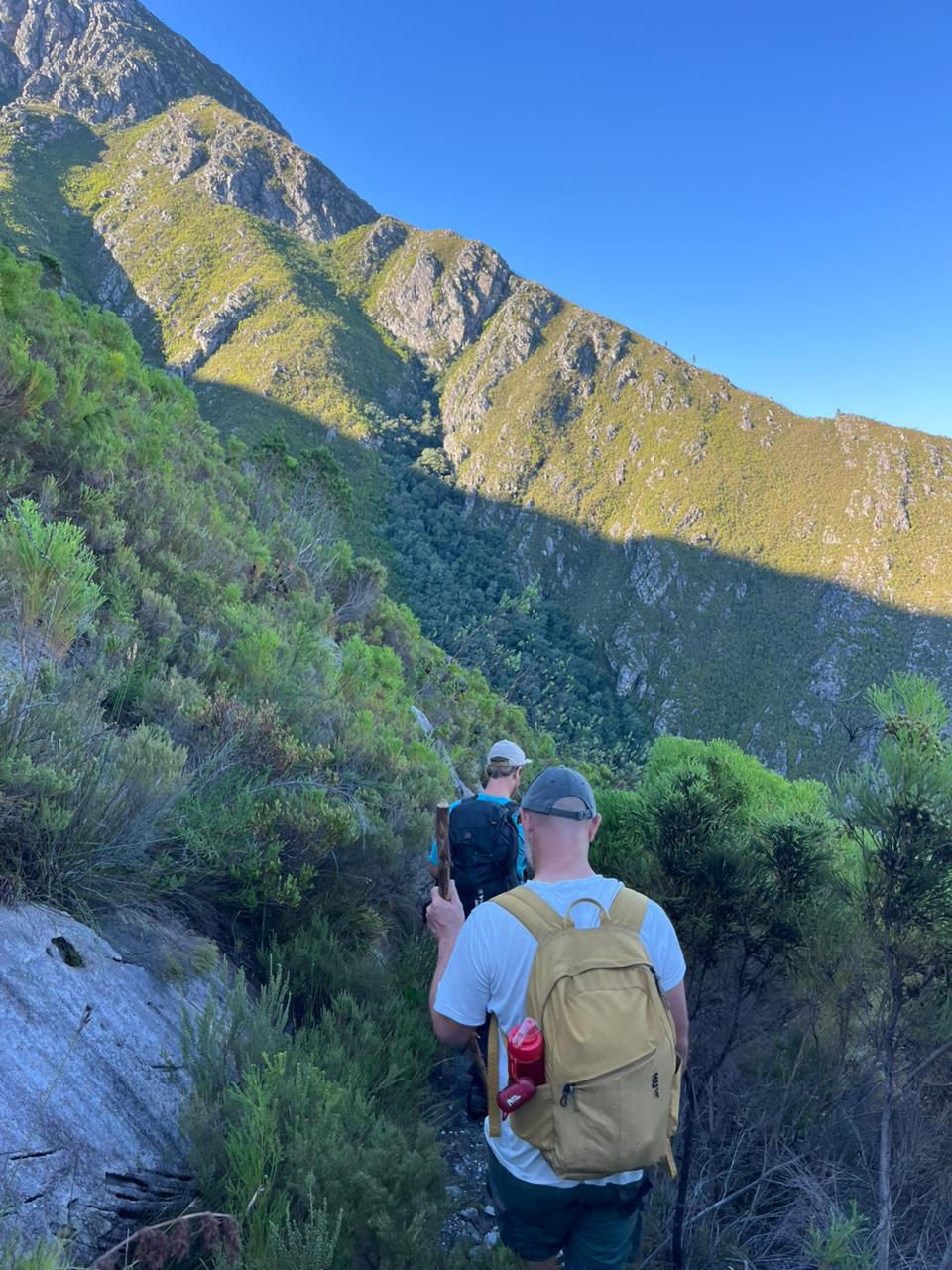
Marloth Nature Reserve is perhaps the most obvious example. CapeNature describes the reserve as a mountain environment dominated by fynbos, with areas of indigenous forest and a range of hiking opportunities. Its trails include shorter walks as well as demanding mountain routes, making the reserve suitable for different levels of outdoor experience.
Bontebok National Park provides another important natural asset. Located just outside town, it offers opportunities for wildlife viewing, birding, hiking, cycling, mountain biking and other outdoor activities.
The combination is particularly useful for remote workers because these activities don't need to consume an entire holiday.
You can explore them gradually.
A short afternoon outing.
A longer weekend hike.
A cycle before work.
A trip to the park on a quiet weekday.
The destination becomes part of your routine rather than a checklist.
What Does a Working Day in Swellendam Look Like?
Imagine arriving in Swellendam for a month rather than a weekend.
You wake up around seven. You make coffee and spend a few minutes outside before starting work. At eight, you open your laptop.
The first part of the day is focused. You have meetings, emails, deadlines and projects. It is still work. The fact that you're in a beautiful location doesn't make the work disappear.
Around lunchtime, you step away. Perhaps you prepare something in the communal kitchen or walk into town. You have lunch, get some fresh air and return to work.
The afternoon is quieter.
A few more hours of focused work.
Then, at four-thirty or five, the laptop closes.
That is when the environment begins to matter.
You could go for a walk. You could cycle. You could meet someone for coffee. You could explore the town. You could head towards the mountains. You could simply sit outside.
The important thing is that your workday has a clear boundary.
The environment gives you somewhere to go.
Later, you might prepare dinner alongside other travellers. Someone has just returned from a hike. Another person is planning a road trip for the weekend. Someone else has been working all afternoon and wants to sit around the fire.
Nobody has organised a networking event.
Nobody has scheduled a "community session".
You're simply living around other people.
And that is often where genuine community happens.
Community Might Matter More Than Wi-Fi
Remote work has solved one major problem: location.
It hasn't solved loneliness.
In fact, working remotely can sometimes make loneliness easier to hide.
You can work successfully from anywhere while spending most of your day alone. If you're travelling by yourself, the problem can become even more pronounced.
You wake up alone, work alone, eat alone and perhaps spend the evening alone.
After a few weeks, even the most beautiful destination can begin to feel isolating.
This is one reason coliving has become increasingly relevant to the remote-work lifestyle.
The idea isn't simply about sharing a building. Good coliving combines private accommodation with spaces where people can interact naturally.
A shared kitchen is a perfect example. Someone making breakfast might start a conversation. Someone cooking dinner might invite another person to join them. A group might decide to hike together the following morning.
These interactions are small, but they matter.
They create the feeling that you're somewhere with other people rather than simply occupying a private rental in an unfamiliar town.
The best community environments also allow people to choose their level of involvement.
You can spend an evening talking around the fire.
You can join a group hike.
You can have dinner with other travellers.
Or you can close your bedroom door and have the evening to yourself.
That balance between independence and connection is one of the most appealing aspects of the modern coliving model.

What Makes a Good Coliving Space?
The physical design of accommodation becomes much more important when people are staying for weeks rather than nights.
A person staying in a hotel for two nights might be perfectly happy with a small room and nowhere to cook. A remote worker staying for a month needs the accommodation to support everyday life.
Reliable internet is obviously essential. A proper workspace can make the difference between being productive and spending eight hours working from a bed. A functional kitchen gives long-term travellers the freedom to prepare their own meals. Laundry facilities become important, as does storage.
But there is another element that is harder to measure.
The place needs to feel comfortable enough that you actually want to spend time there.
Outdoor space matters.
Communal areas matter.
A garden matters.
A fire pit matters.
A mountain view matters.
The physical environment influences how people behave.
If there is a comfortable table outside, people sit outside. If there is a communal kitchen, people cook together. If there is a fire in the evening, people gather around it.
Good coliving is therefore partly about architecture and partly about creating opportunities for natural interaction.
The goal isn't to force community.
It is to make community possible.
Why Nature Changes the Remote-Work Equation
One of the biggest benefits of working from a smaller town is that nature can become part of everyday life rather than something reserved for weekends.
In a large city, you may need to deliberately plan a trip into nature. You might drive for an hour to reach a trail, spend the day there and return home exhausted.
In Swellendam, the natural environment is part of the town's immediate surroundings.
The Langeberg Mountains dominate the landscape. Marloth Nature Reserve provides access to mountain trails. Bontebok National Park is close to town. The Breede River adds another dimension to the area.
This changes the way you can use your free time.
A 45-minute walk after work becomes realistic.
A quick cycle becomes realistic.
A short drive into the countryside becomes realistic.
You don't need to turn every outdoor experience into a full-day expedition.
That is particularly valuable for people who spend much of their working day sitting at a computer.
The workday can be mentally intense.
Being able to change your environment afterwards, move your body and spend time outside is a simple but powerful counterbalance.
The Appeal of a Month in Swellendam
There is a point at which a destination stops feeling like a holiday.
That might happen after a week.
It might take a month.
But once it happens, the way you experience the place changes.
During your first week in Swellendam, you might explore the obvious attractions. You might walk around the historic centre, visit restaurants, find the shops and start exploring the surrounding landscape.
During the second week, you might begin to develop a routine.
You know where you like to work.
You know where to get coffee.
You know the best time for a walk.
You start recognising people.
By the third week, you might be spending more time doing ordinary things. Shopping. Cooking. Working. Reading. Walking.
And then something interesting happens.
You realise you don't need to be entertained.
You are simply living.
That's the real advantage of slow travel.
You have enough time to experience the destination without constantly needing to extract an experience from it.
Who Is This Lifestyle Actually For?
Small-town remote work isn't for everyone.
Someone who wants nightlife every evening, international restaurants on every street and a constant flow of events may be happier in Cape Town or another major city.
But there is a growing group of travellers for whom those things matter less.
Freelancers are an obvious example because they can often choose where they work. Remote employees may have similar flexibility if their employers permit international or location-independent work. Entrepreneurs, designers, developers, writers and content creators can also benefit from a quieter environment.
Long-term travellers are another natural audience.
Someone travelling for six months doesn't necessarily want to spend every week moving. They may prefer to establish several temporary bases, staying for three or four weeks in each.
Solo travellers can also benefit from the community element.
A private apartment can provide privacy, but it can also create isolation. A social lodge or coliving environment can provide opportunities to meet people without requiring the traveller to sacrifice independence.
For couples, there is another advantage. Two people who both work remotely can live somewhere new while exploring together outside working hours.
In all of these cases, the attraction is essentially the same.
The ability to combine work with a better everyday environment.
The Future of Digital Nomadism May Be Slower
The first generation of digital nomads often measured their freedom by how quickly they could move.
The next generation may measure it by how long they can stay.
That sounds like a small distinction, but it changes the entire travel experience.
Staying longer means spending less time packing. It means learning a destination more deeply. It means spending money in local businesses repeatedly rather than simply passing through. It means developing relationships. It means becoming familiar with the landscape.
It also makes accommodation more interesting.
A room isn't simply a place to sleep between adventures anymore.
It becomes a temporary home.
The kitchen becomes important.
The workspace becomes important.
The communal areas become important.
The surrounding environment becomes important.
And this creates a significant opportunity for accommodation providers in smaller destinations.
Instead of competing solely for one-night bookings, they can build an offer around people who want to stay for a week, a month or longer.
Swellendam as a Case Study
Swellendam doesn't need to become another Bali.
It doesn't need hundreds of digital nomads arriving every month.
In fact, trying to replicate the world's established digital-nomad hubs could undermine what makes the town attractive.
The opportunity is much simpler.
Make it easy for the right kind of traveller to stay longer.
Provide accommodation that works for people who are living rather than simply sleeping.
Make reliable connectivity part of the experience.
Create spaces where travellers can work and socialise.
Connect people with the surrounding outdoor environment.
And let the town itself remain what it is.
A small historic community beneath the Langeberg Mountains.
That is enough.
The current accommodation market already shows signs of this longer-stay opportunity. Furnished monthly accommodation is available in the Swellendam area, with platforms specifically marketing monthly stays to digital nomads and travelling professionals and highlighting features such as Wi-Fi and laptop-friendly workspaces.
The market is still developing, but the direction is interesting.
Kliprivier Mountain Lodge and the Long-Stay Traveller
This is where Kliprivier Mountain Lodge fits naturally into the broader story.
The traditional accommodation question is straightforward: where are you going to sleep tonight?
For a long-stay traveller, the question becomes much more important.
Where are you going to base yourself?
Where will you work?
Where will you cook?
Where will you meet people?
Where will you spend your evenings?
Where will you go when you want to get outside?
Kliprivier Mountain Lodge sits within that intersection between accommodation, nature and community.
For a backpacker, it can be part of a journey through the Western Cape. For a slow traveller, it can provide a base for exploring Swellendam and the wider Overberg. For a remote worker or digital nomad, the same environment can become a temporary home.
The difference is the length of stay.
A person staying one night experiences the lodge as accommodation.
Someone staying three weeks experiences it as part of their lifestyle.
They become familiar with the spaces. They meet other travellers. They discover the surrounding area. They establish routines.
That is precisely where the concept of community becomes valuable.
The lodge doesn't have to provide every possible form of entertainment because the surrounding environment already provides much of it.
The mountains are there.
The town is there.
The trails are there.
The road network is there.
The people are there.
The lodge can simply provide the base.

Maybe the Future Isn't More Travel
There is an irony at the heart of digital nomadism.
Technology gave people the freedom to work from almost anywhere, and the first instinct was to go everywhere.
People travelled faster.
They changed countries more often.
They collected destinations.
But perhaps the next phase will be different.
Maybe the real benefit of location independence isn't that you can travel constantly.
Maybe it is that you can choose where you want to spend your time.
You can stay somewhere for a month.
You can work from there.
You can explore slowly.
You can meet people.
You can develop routines.
You can have ordinary days.
And then, when you're ready, you can move somewhere else.
That's a different kind of freedom.
It isn't the freedom to constantly leave.
It is the freedom to choose where you stay.
Why Small Towns Could Be the Future
Small towns don't need to compete with cities on the things cities are good at.
They don't need more skyscrapers.
They don't need enormous entertainment districts.
They don't need hundreds of restaurants.
They don't need to become international hubs.
They can compete on something much harder to manufacture.
Space.
Quiet.
Nature.
Community.
A sense of place.
Time.
Those are increasingly valuable commodities for people who spend their working lives online.
The paradox of remote work is that your physical environment becomes more important when your work no longer determines where that environment has to be.
If your office can be anywhere, why not choose somewhere you actually enjoy living?
That could mean an apartment in central Cape Town.
It could mean a beach house in Portugal.
Or it could mean a small room in a mountain town in the Western Cape.
The answer depends entirely on what kind of life you want outside working hours.
Maybe You Don't Need to Be a Digital Nomad
You don't necessarily need to identify as a digital nomad to benefit from this lifestyle.
Perhaps you simply have a job that allows you to work remotely for a few weeks.
Perhaps you run a freelance business.
Perhaps you own an online company.
Perhaps you're between projects and want to spend a month somewhere new.
Perhaps you want to combine a holiday with normal working days rather than taking
an entire month off.
The important development isn't really the label.
It's the flexibility.
Technology has made it possible for more people to separate their work location from
their home location.
Once that happens, places that previously had little reason to attract international workers suddenly become possible.
A small town doesn't need to persuade someone to relocate permanently.
It only needs to give them a good reason to stay for a while.
So, Could Swellendam Become a Digital Nomad Destination?
Perhaps.
But it may be more useful to ask a different question.
Could Swellendam become a place where digital nomads want to stay longer?
That feels much more realistic.
The foundations already exist. The town has a strategic position, natural attractions, accommodation, restaurants, shops and access to the broader Overberg. The surrounding mountains provide a genuine outdoor lifestyle rather than a manufactured tourism experience.
The challenge is making the experience work for people who are not simply visiting.
That means reliable connectivity, appropriate accommodation, comfortable workspaces and opportunities for community.
It also means recognising that remote workers aren't necessarily looking for a conventional holiday.
They are looking for somewhere they can build a temporary routine.
And that is precisely where smaller towns have an opportunity.
A Different Way to Travel
Perhaps the future of travel isn't about seeing more places.
Perhaps it's about seeing fewer places more deeply.
Instead of spending three nights in ten destinations, spend three weeks in three.
Instead of rushing through Swellendam on the way to the Garden Route, stay long enough to discover why people live there.
Work during the day.
Explore in the afternoon.
Meet people in the evening.
Take longer trips on weekends.
Eventually, the mountains become familiar.
The town becomes familiar.
Your routine becomes familiar.
And somewhere along the way, the distinction between travelling and living begins to disappear.
That's the real promise of remote work.
Not that you can work from anywhere.
That you can choose where you want your life to happen.
For some people, that will always mean a city.
For others, it may mean a mountain town.
And for an increasing number of travellers, the idea of waking up beneath the Langeberg Mountains, opening a laptop for a few hours and then spending the afternoon outside may be exactly what they were looking for.
Perhaps the future of digital nomadism isn't about travelling further.
Perhaps it is about staying somewhere long enough to call it home.
Even if that home is only temporary.
Frequently Asked Questions
Is Swellendam a good destination for digital nomads?
Swellendam can be particularly appealing to remote workers who value nature, outdoor activities, a slower pace of life and community. It is considerably smaller and quieter than Cape Town, so it is best suited to people who prefer a relaxed environment rather than a major urban centre.
Can you work remotely from Swellendam?
Yes. Remote workers can work from suitable accommodation, private workspaces and other locations with reliable internet. Anyone planning a longer stay should confirm current internet speeds, workspace facilities and power arrangements with their accommodation before booking.
Is Swellendam suitable for long stays?
Swellendam is well suited to longer stays because it combines everyday town infrastructure with extensive outdoor opportunities. Its position also makes it a useful base for exploring the wider Overberg, Route 62 and destinations towards the Garden Route.
What can you do after work in Swellendam?
The area offers hiking, walking, cycling, mountain biking, wildlife viewing, scenic drives and other outdoor activities. Marloth Nature Reserve provides access to a variety of mountain trails, while Bontebok National Park offers hiking, cycling, wildlife viewing and other nature-based activities.
Does South Africa have a digital nomad visa?
South Africa has introduced a remote-work visa framework for qualifying foreign nationals working remotely for foreign employers. The current framework has specific eligibility requirements, so anyone considering applying should consult the latest information from the South African Department of Home Affairs before making travel arrangements.
What is coliving?
Coliving combines private accommodation with shared spaces and opportunities for social interaction. It is particularly suited to digital nomads, remote workers, freelancers and long-term travellers who want the privacy of their own accommodation while still having opportunities to meet other people.
Is Swellendam already a major digital-nomad hub?
Swellendam is not currently a major international digital-nomad hub in the same way as Cape Town, Lisbon or Bali. Its appeal lies in offering an alternative to those destinations, particularly for travellers looking for nature, community, space and slower living.

Comments